News World
Repos
The GitHub repos to build on, with their stars, licence, last commit on the day of the check, and what they do not cover.
Nothing for that search in the published issues.
Repos
Issue 009 · deepseek v4.1 flash is back, under an mit license
kitlangton/scrawl · ★ 546 · MIT · last commit October 20, 2026
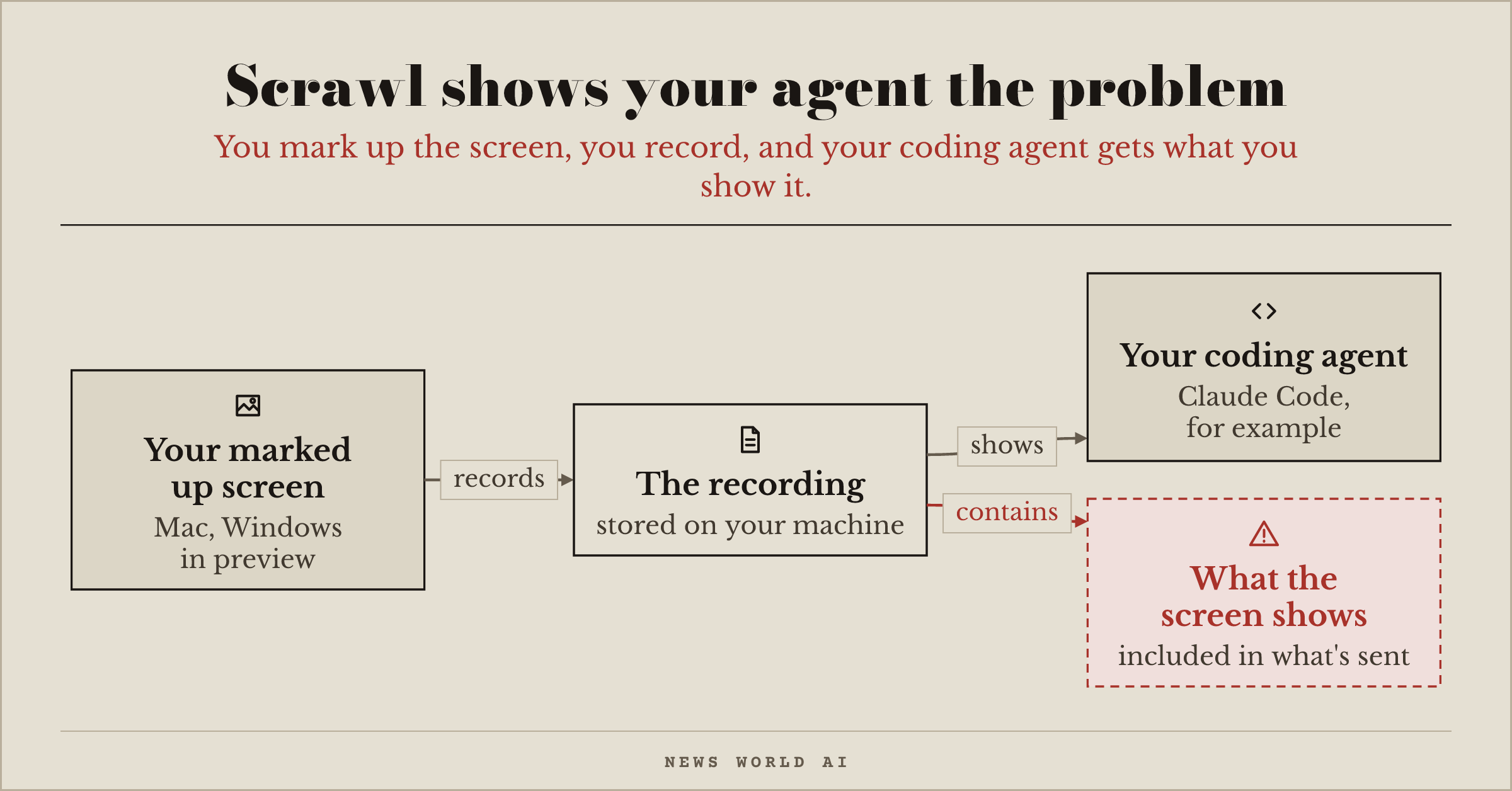
Show your agent a problem instead of describing it: you mark up the screen, you record, you send. It runs on a Mac (Apple silicon, macOS 26), in preview on Windows, and it is presented for Claude Code and other coding agents. Captures are stored in a folder on your machine, and the agent gets keyframes and a summary (summary.md) holding the transcript, made on the device, and the timeline. In issue 008, big-arrow-on-the-screen did the opposite, the agent drew arrows for you; scrawl opens the other direction of the conversation. What it does not do: it fixes nothing, and it provides no model that answers, only transcription: your agent does the answering.
Graphicle-AI/graphicle · ★ 330 · Apache-2.0 · last commit October 18, 2026
A map of your code and a memory for your coding agents, in a single program, plugged in over MCP (the standard way agents plug in) to Claude Code, Codex, Cursor or any other MCP client. The agent finds out what calls what and what it has already learned about the project, and gets cited excerpts, with the file and the lines. The same week, Tencent released Hy-Memory-30B-A3B, a model dedicated to memory. The organization behind graphicle is only three weeks old. Notes the agent proposes wait for your approval, and by default a project can hold up to 100,000 text files and 1 GiB of text. What it does not do: it does not list the languages it reads.
eliasbiondo/antirion · ★ 134 · Apache-2.0 · last commit October 18, 2026
A three day old project: an open source AI gateway, a single program with its console: all your model calls (OpenAI, Anthropic, Gemini, Bedrock and others) go through it, and it routes them, monitors them and sets them a budget. In issue 007, our problem was a spending cap that really cuts off: antirion sets it in one place for every provider, and your keys are no longer scattered across every tool. What it does not do: it has no hosted version, you have to install and maintain it yourself, and it has no independent measurement of its speed: the median overhead of 0.53 ms against 19.7 ms for Bifrost, at 5,000 requests per second, comes from the project's own benchmark.
strands-agents/harness-sdk · ★ 8,878 · Apache-2.0 · last commit October 20, 2026
The established project in this section: a kit for building and controlling an agent's harness, meaning everything around the model (the work loop, the tools, the rules), in Python and TypeScript, with any model and any server provider. In issue 007, the same organization released Box, its box for agents. In early October, Google Research released Harness², a framework that improves the harness by itself, with the model left unchanged. What it does not do: it is not a ready made app, you have to write code or have it written, and it has no hosted service: it runs inside your own program.
Issue 008 · windows gets its box for agents
onehumanbeing/esp32-iphone-agent · ★ 1,411 · MIT · last commit October 13, 2026
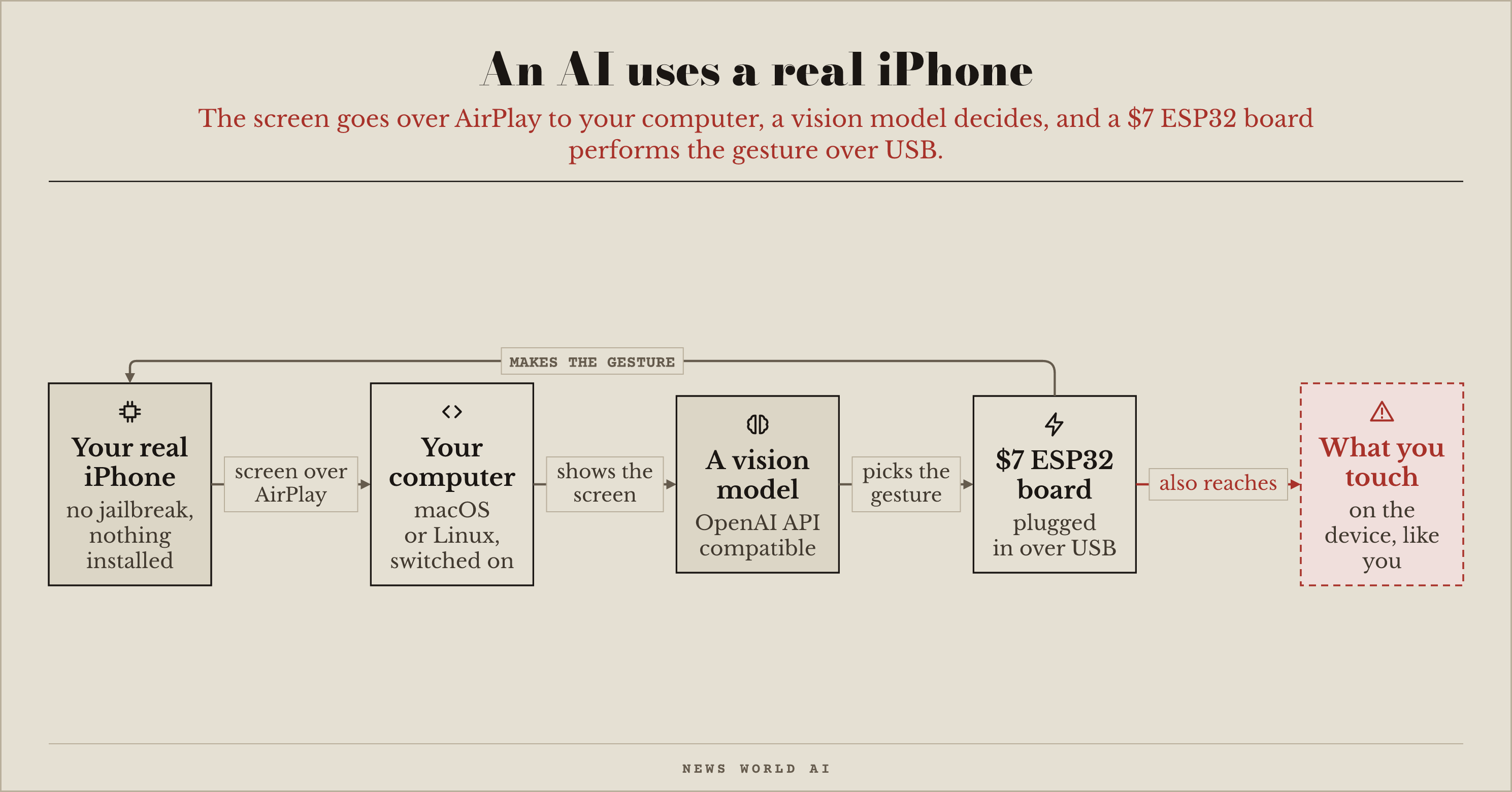
An AI model uses a real iPhone through an ESP32, a small $7 circuit board. The screen goes over AirPlay to your computer, and the board, plugged in over USB, shows up on the phone as an ordinary mouse and keyboard: the agent touches what you touch on the device (see The security reflex). Any vision model compatible with OpenAI's API picks the next gesture. Nothing to install on the phone, no developer account, no jailbreak. What it does not do: it does nothing without the board, or without a macOS or Linux computer switched on and on the same network. The agent does not see passcode entry, Apple Pay or protected videos. No reliability measurement has been published.
bherbruck/solidcraft · ★ 1,609 · MIT or Apache-2.0 · last commit October 13, 2026
Software for designing 3D parts where every part is dimensioned and changes when you edit a value (this is called parametric CAD), open source and written in Rust (a programming language): a desktop app, a web version, and control through MCP, the standard way agents plug in, so that an agent can build or modify a part for you. It reads and writes the common file formats of manufacturing and 3D printing (STEP, IGES, 3MF, STL, OBJ). Created on October 7, it passed 1,500 stars in six days and was shown on Hacker News on October 13 (more than 100 points). In issue 000, text-to-cad turned a description into a CAD file, with no way to see the part; SolidCraft is the application itself, with the agent plugged into it. The same shift shows in blokkily, an experimental music program that accepts MCP. What it does not do: it produces neither 2D technical drawings nor instructions for manufacturing machines, both deferred until further notice on its roadmap, and for now its repository only calls it usable for simple parts.
franzenzenhofer/big-arrow-on-the-screen · ★ 689 · MIT · last commit October 12, 2026
Your agent draws big arrows, boxes and text on your Mac's screen to show you where to click: a single command, an overlay your clicks pass through, and that disappears on its own. It ships as a skill (a set of instructions the agent loads) for Claude Code and Codex, and drew 418 points and 196 comments on Hacker News on October 9. For people who build without being engineers, this is the agent showing instead of describing, in an interface they do not know. What it does not do: it draws, but it does not click, type or capture the screen. Mac only.
dagucloud/dagu · ★ 4,341 · GPL-3.0 · last commit October 13, 2026
The established project in this section: a program you install on your own machine that runs your tasks at a set time or one after another. In a plain text settings file (the YAML format), you describe the sequence of your scripts and of the commands sent to other machines; a single program, no database. In issue 007, we left an agent alone overnight: dagu is where you would schedule that task at a fixed time, next to the spending cap. And when the steps are known in advance, a fixed sequence costs less than an agent and does the same thing every time. Its GPL-3.0 license requires anyone who redistributes a modified version to provide its source code to the people who receive it. What it does not do: it decides nothing, it runs what you wrote, in order. It only runs on a machine of your own, switched on, and has no hosted version that runs your tasks: execution stays on your servers.
Issue 007 · decision models you can download
strands-agents/box · ★ 208 · Apache-2.0 · last commit October 7, 2026
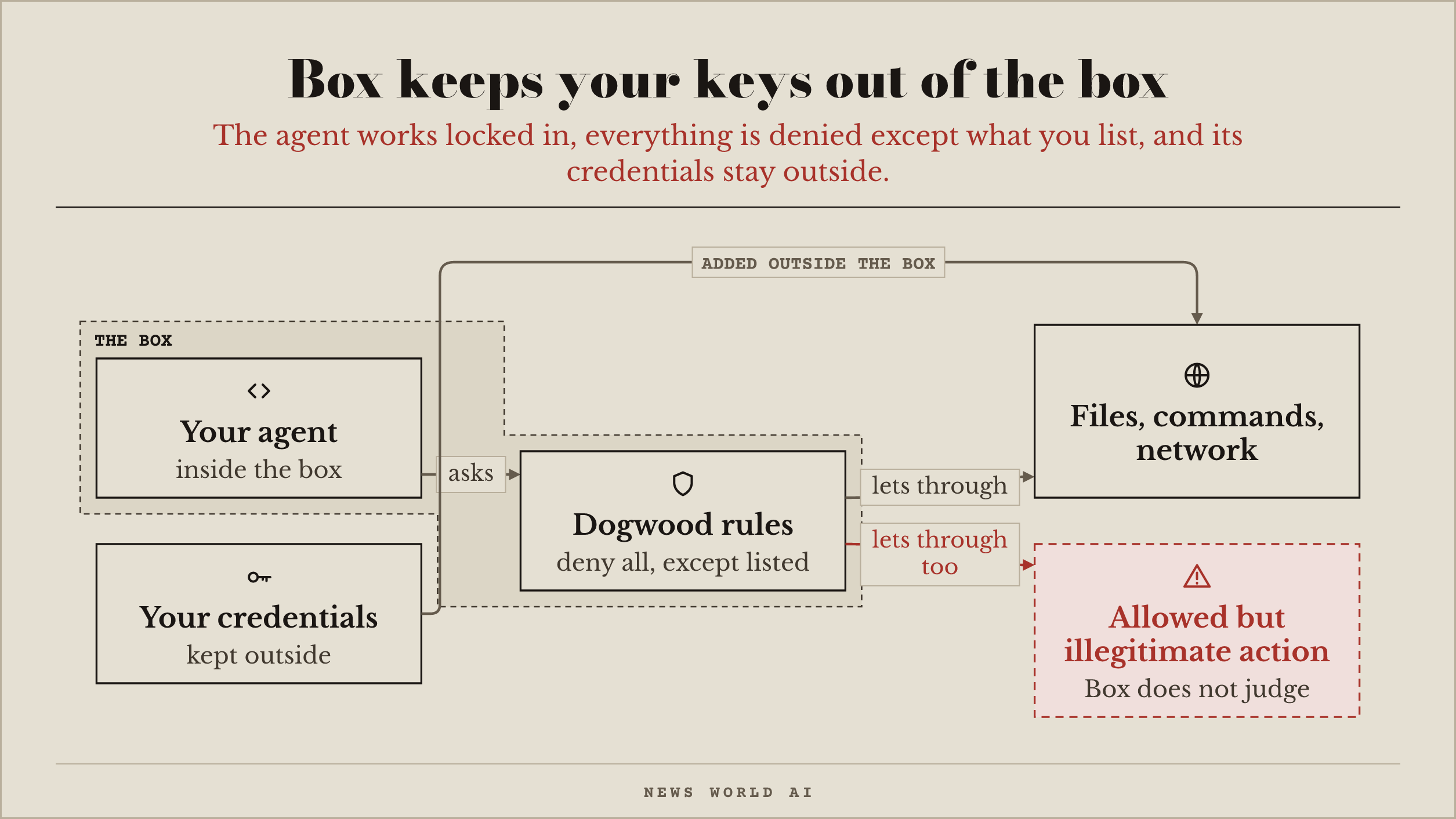
A sandbox for agents, published by the organization behind the Strands Agents kit: it limits what the agent can run, read, write and reach on the network. Its rules, called Dogwood, deny everything by default, and Box supplies your credentials from outside: the secrets stay out of the box. In issue 006, our problem of the week ended on "an agent locked up with your keys can still use them"; Box tackles that point. What it does not do: it does not write the list of what gets through for you, and does not judge whether an allowed action is legitimate. It does not run on Linux (planned) or Windows: only on Apple silicon Macs, with macOS 15 or later.
openqodex/openqodex · ★ 400 · Apache-2.0 · last commit October 8, 2026
An AI code review before you send your changes, for Claude Code and Codex, made by Qodex, which also runs a hosted review of every pull request. Analyzers look for known vulnerabilities, forgotten secrets, risky dependencies and style mistakes on the changed lines only, then a second, separate program checks each alert before showing it to you. OpenAI offers the same function with codex-security (11,029 stars, Apache-2.0), and GitHub publishes a benchmark to compare these reviewers (see In brief). What it does not do: it only looks at the changed lines, not at an older flaw elsewhere in the code, and it does not guarantee to find everything. It has published no score on that benchmark.
toby-bridges/api-relay-audit · ★ 872 · AGPL-3.0 · last commit October 8, 2026
Do you go through a relay that resells access to Claude or GPT for less? This tool audits it from your machine: instructions slipped into your requests, a model swapped for another (you pay for one, you are served the other), rewritten tool calls, answers that come back mangled, leaks in error messages. In issue 006, we warned about a plugin promising a "free and unlimited" model: here is a way to test that kind of middleman before trusting it with your requests. What it does not do: it reports what it saw at the moment you run it, it does not monitor continuously, and a relay can change afterwards. It does not make a relay safe. It does not prove that a model was swapped: the identity the model gives itself, anchor phrases, response time and technical fingerprints are clues, not proof on their own, the repository says.
Issue 006 · two open answers to jev's idea
nokia-applied-research/AnyJev · ★ 894 · Apache-2.0 · last commit September 28, 2026
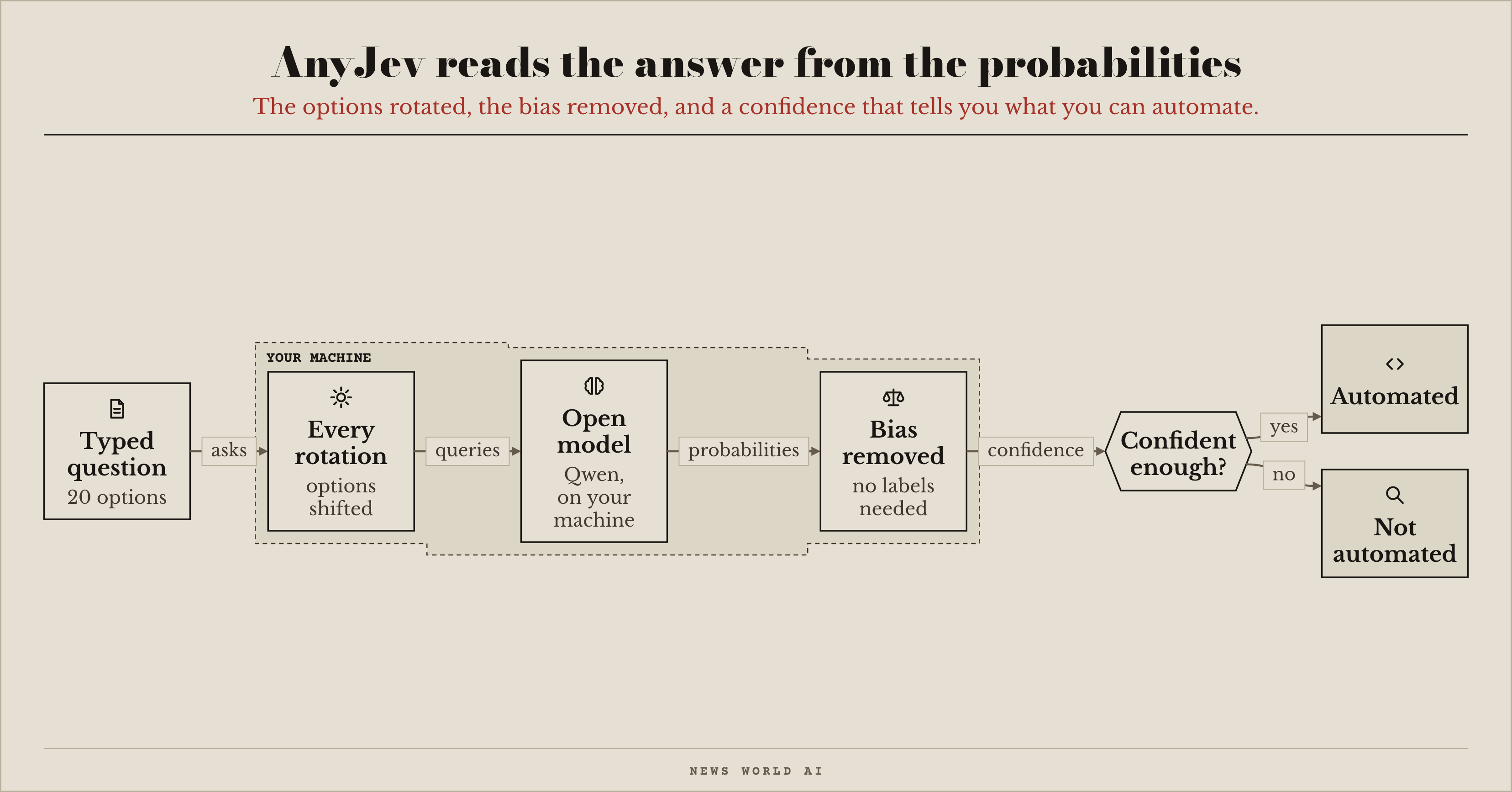
A research library from Nokia (the anyjev 0.2.0 package on PyPI) that asks an open model a typed question the way Jev does and reads its answer from its internal probabilities. Read as is, the answer changes when you reverse the order of the options, and a confidence of 0.9 does not mean 90%. AnyJev rotates the order of the options and removes the model's bias toward certain labels, without a labeled example. With 100 to 500 labeled examples, it also calibrates the confidence. On sorting banking messages into 20 categories, the authors measure that the share of cases you can automate with at most 5% errors rises from 7.7% to 46.3% without labels: a measurement on a single model (Qwen3-8B) and 300 cases, which they themselves call highly uncertain. What it does not do: it only works with an open model you run yourself, never Claude, GPT or Jev through their APIs. It does not make a model right when it does not know the answer, and its repository states it has no connection to TypeSafe.
github.com/nokia-applied-research/…
Accuracy moves only six points (74.7%, 80.3%, 80.7%), but the confidence becomes reliable: it is the confidence that decides what goes out without review.
mikehasa/golive-skill · ★ 1,055 · MIT · last commit September 29, 2026
An agent skill and a small command‑line tool that put what your agent has built online: hosting, database, domain name, email, payments, on your own accounts, with an approval step before anything is applied and a check afterwards. What it does not do: it hosts nothing and pays for nothing on your behalf, the accounts and the bills stay yours.
yetone/magpie · ★ 1,720 · MIT · last commit September 29, 2026
You choose which model powers each coding agent: Codex on DeepSeek, Claude Code on Kimi. It runs on macOS, Linux and Windows, with a menu bar app. What it does not do: it provides neither a model nor a key, you need your own subscriptions.
Issue 005 · jev ticks a box, your code decides
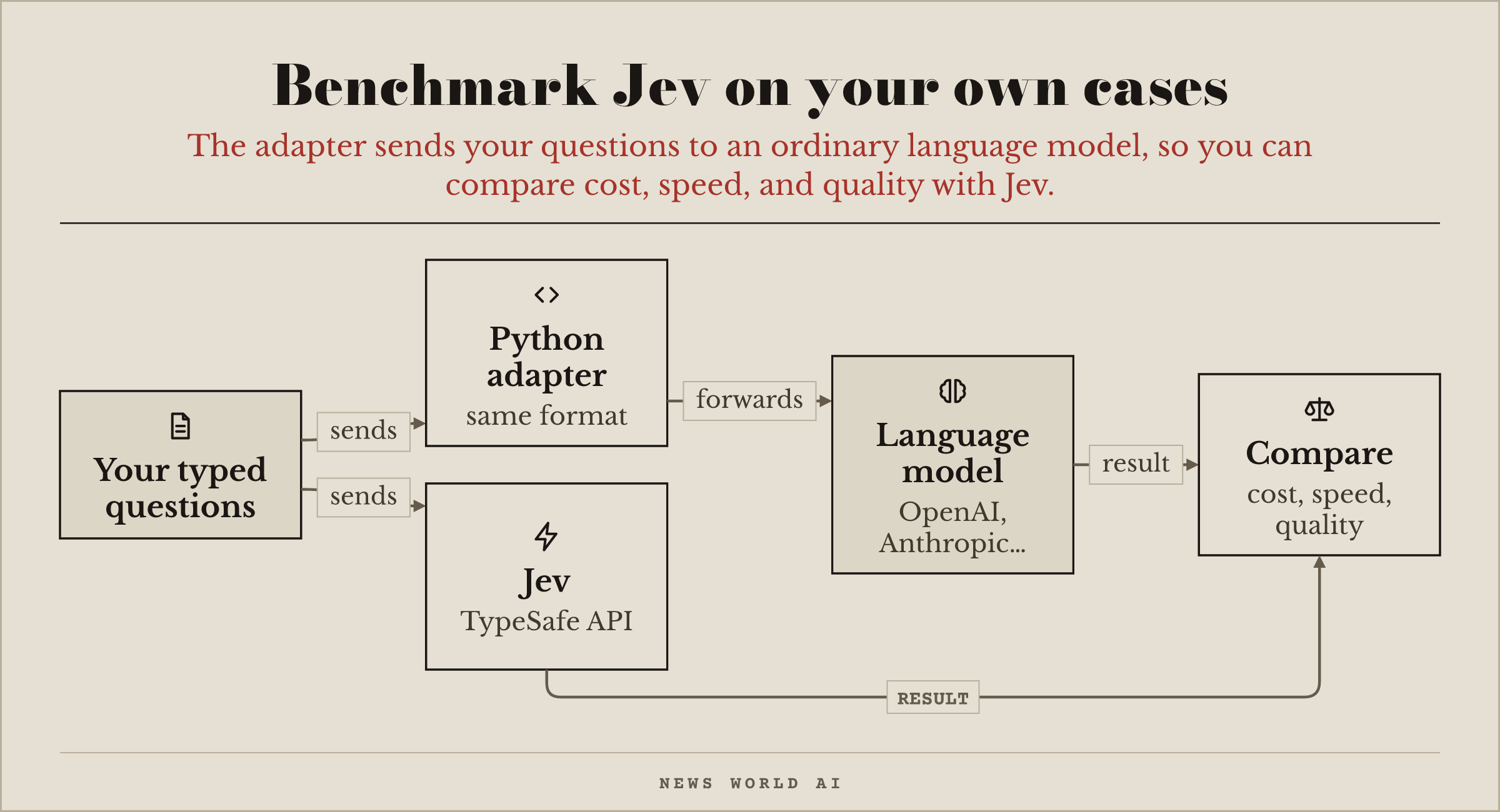
typesafe-ai/system-one-adapter-python · ★ 257 · MIT · last commit September 22, 2026
Has an ordinary language model (OpenAI, Anthropic, Google Gemini, or any OpenAI-compatible service) answer the same typed questions as Jev. A way to compare cost, speed, and quality on your own cases before trusting the vendor's numbers. What it does not do: it does not give you access to Jev, and it does not choose the test cases for you.
awlevin/typesafe-computer-use · ★ 814 · MIT · last commit September 18, 2026
An agent drives the macOS desktop: screenshot, next action chosen by Jev, click. Announced cost: $0.0002 per step. What it does not do: it runs only on macOS, sees only the main display, reads only the buttons of apps that describe them to the system, and does not work without the TypeSafe API.
fujibee/agmsg · ★ 1,515 · MIT · last commit September 22, 2026
Messaging between coding agents: Claude Code, Codex, Gemini, and Copilot talk on the command line, with Bash and SQLite, no service to install. What it does not do: it does not use the network, the agents share a single SQLite file.
Issue 004 · knowing what the agent did
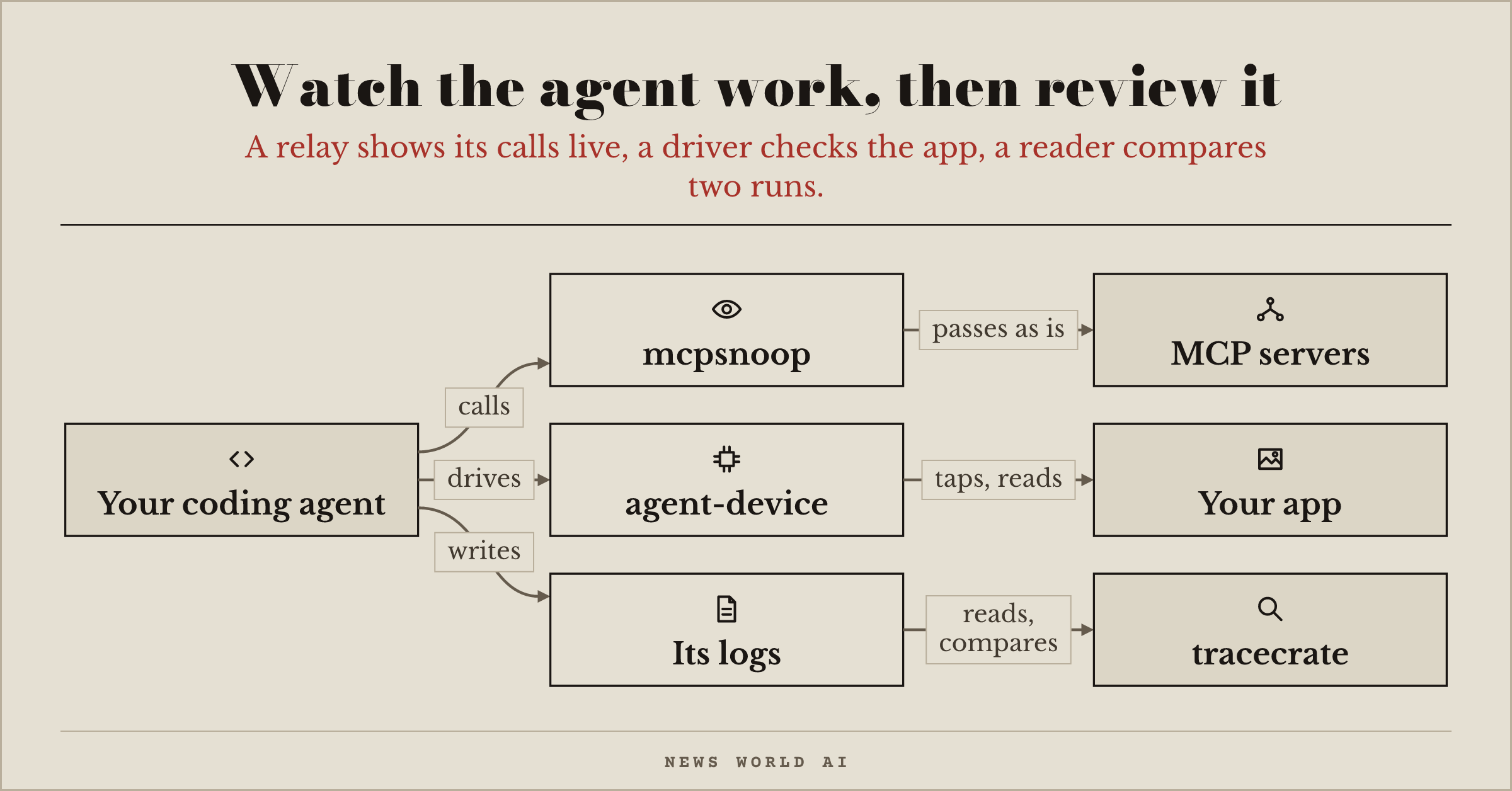
callstack/agent-device · ★ 4,585 · MIT · last commit September 15, 2026
Your coding agent can drive an app on iOS, Android or HarmonyOS (simulator, emulator or a real phone): tap the screen, read what it shows, verify the result. Each run is saved as a script you can replay for testing. The publisher is Callstack, a React Native services company. What it does not do: does not fix a broken replay script by itself.
kerlenton/mcpsnoop · ★ 349 · MIT · last commit September 11, 2026
Sits between your assistant (Cursor, Claude Code, Codex) and its MCP servers, the connectors that give it access to your tools, and shows every tool call actually sent, live. Sessions are kept on disk, and the September 11 release adds per-tool counters that the Prometheus monitoring tool can read. What it does not do: does not block or modify any call.
FankChen/tracecrate · ★ 123 · MIT · last commit September 13, 2026
Reads Claude Code and Codex logs, plus traces in OTLP (OpenTelemetry's standard trace format), compares two runs and exports a redacted report. No server, no account, no keys: it runs in your browser. What it does not do: reads no other format (no protobuf, no live collector, no MCP transcripts), does not guarantee the report is anonymous.
Issue 003 · what your coding agent sends home
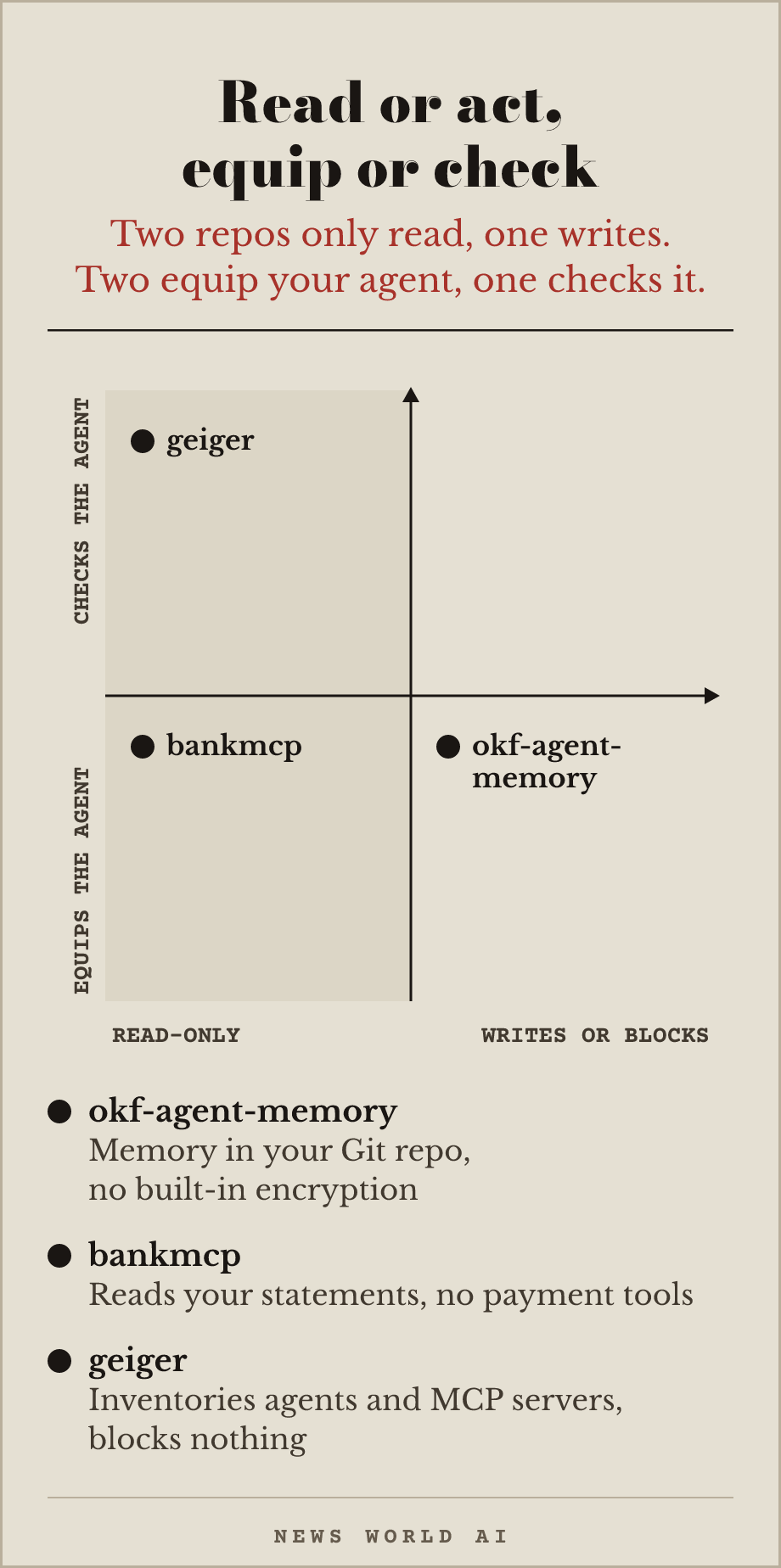
okf-memory/okf-agent-memory · 552 stars · MIT · last commit 9 September 2026
Persistent memory for coding agents, kept in your Git repo as text files. Claims search in under 300 microseconds, ships an MCP server, and claims 80% fewer tokens in its own benchmark. What it does not do: no built-in encryption (everything is plain text), no conflict handling when two agents write at the same time, no remote shared memory yet.
noskillish/bankmcp · 178 stars · MIT · last commit 8 September 2026
A self-hosted, read-only MCP server that queries your own bank accounts via open banking (the set of standards that let authorised software access your accounts), through Enable Banking. Tested with Claude and Claude Code, and experimentally with local models via Ollama. Your agent can read your statements: the server has no payment tools. What it does not do: no payments, no bank outside Enable Banking's network, one user per server, no hosted version.
Atomburstofficial/geiger · 106 stars · MIT · last commit 10 September 2026
A read-only command that inventories the AI agents, MCP servers, extensions and hooks found in known configuration locations. It answers a question most people cannot: what runs on this machine, and what can it reach? What it does not do: does not monitor continuously, does not block anything, does not tell you what an agent actually did.
Issue 002 · A newsroom with no journalists
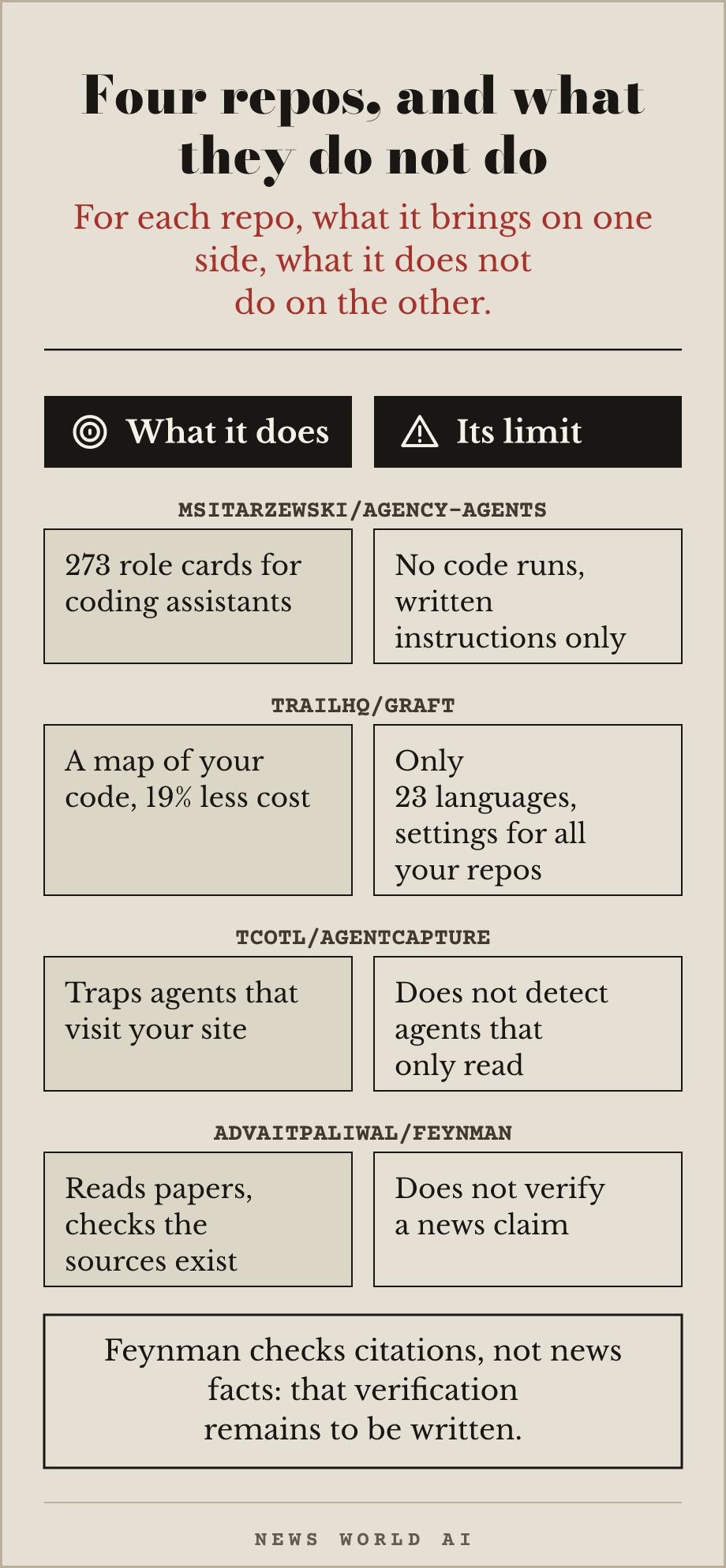
msitarzewski/agency-agents · 150,281 stars · MIT · last commit 5 September 2026
A library of role cards for coding assistants. Each card is a text file describing a specialist (security, testing, SEO, finance) that you drop into your tool. The repo announces more than 230 agents. Our own count after cloning, on 6 September 2026, gives 273 cards. What it does not do: no code runs, these are written instructions only. The cost is whatever the model reading them charges. The project itself documents that some tools only register part of the cards and silently drop the rest.
trailhq/Graft · 5,609 stars · MIT · last commit 2 September 2026
It maps your code, in text, and gives the map to your coding assistant so it stops re-reading the entire repo on every question. Its standard protocol (SWE-bench Verified, 50 cases, same model on both sides) shows 19% less cost and 12 more accuracy points. What it does not do: it understands only 23 languages and ignores the rest, and it does not confine itself to the current repo unless you ask it to. The plain-language summaries require an API key and cost money, only the structural map is free. Its install command writes settings for all your repos, unless you pass --no-global.
Tcotl/AgentCapture · 35 stars · AGPL-3.0 · last commit 4 September 2026
A honeypot for agents: 23 techniques to identify an agent visiting your site, trap it, and replay its session. Tested against five mainstream agents, all trapped. What it does not do: does not detect agents that only read without interacting. It does not block anything either, it watches and records, the decision stays yours.
advaitpaliwal/feynman · 8,871 stars · MIT · last commit 6 September 2026
A command-line assistant that fetches scientific papers (arXiv, PubMed, OpenAlex, ClinicalTrials.gov), reads them, ranks them, produces a synthesis, and checks that every cited source actually exists. What it does not do: its ground is scientific literature, not current events. It does not verify a news claim. You must plug in your own model, and running heavy experiments means installing Docker, Modal or RunPod yourself.
Issue 000 · Your agent succeeds one time in three
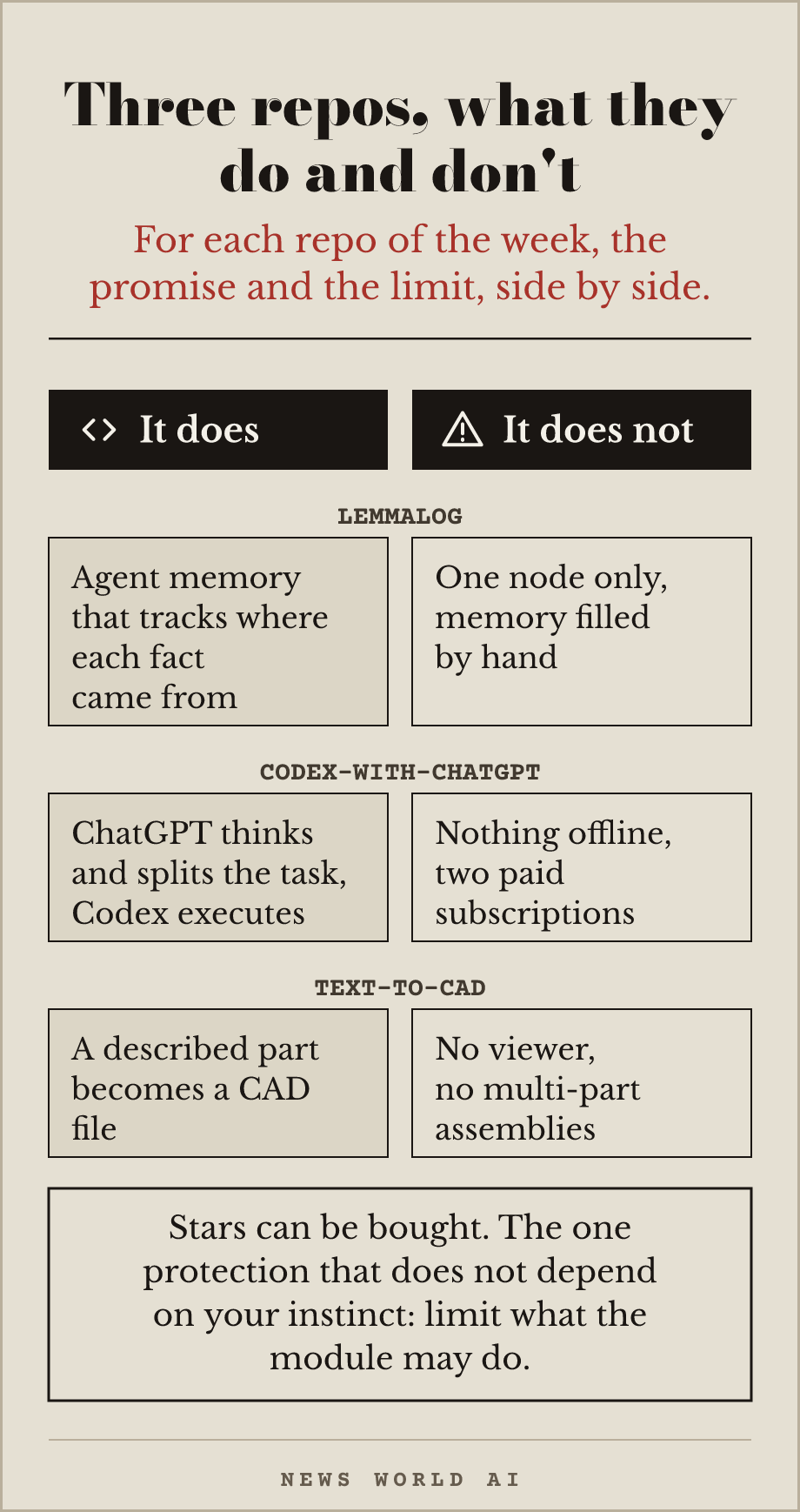
JordyZomer/lemmalog — 242 stars, MIT licence, last commit 27 August 2026 Memory for agents that keeps track of where each fact came from. Ships an MCP server, so it plugs straight into your agent.
What it does not do one node only, no distribution, and memory is filled by hand: nothing is extracted from conversations on its own.
Few stars, young project: that is normal and says nothing about quality. The risk here is not a trap, it is abandonment in three months.
→ github.com/JordyZomer/lemmalog
XiaoDuoYa/codex-with-chatgpt — 2,072 stars, MIT licence, last commit 28 August 2026 ChatGPT thinks and splits the task, Codex executes.
What it does not do nothing offline, and it leans on two paid subscriptions. If either provider closes the tap, the whole rig stops, and that does happen.
→ github.com/XiaoDuoYa/codex-with-chatgpt
earthtojake/text-to-cad — 14,101 stars, MIT licence, last commit 1 September 2026 Describe a part in plain English, get the computer-aided design file back.
What it does not do no viewer, you need external CAD software to open the result, and it does not handle multi-part assemblies.
→ github.com/earthtojake/text-to-cad
A warning that holds for the whole section. Stars can be bought, a few cents each. A project with fifty thousand stars, twelve forks and no discussion does not happen naturally. None of these tests proves anything, they only say where to look. The one protection that does not depend on your instinct is limiting what the module is allowed to do.
The archive reproduces each issue as it went out, without rewriting it. A repo's stars, prices and last-commit dates are those of the day of the check, not today's: follow the link for the current state.
Geneva, Switzerland. Write to hello@newsworldai.xyz.