News World
A newsroom with no journalists
Hello,
This issue is built around one question: can you assemble a news pipeline run by machines, from collection to editing? Five layers, six real tools, one hole at the second, and the bill that comes with it.
Releases
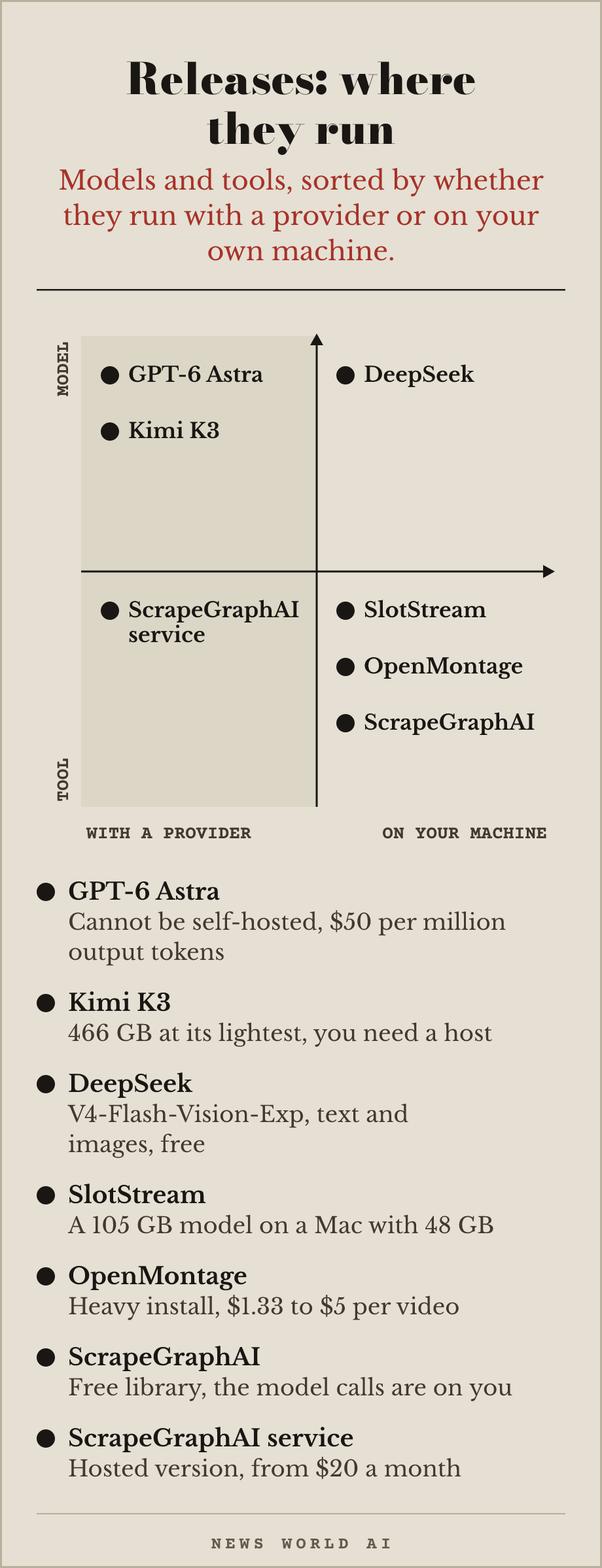
GPT-6 Astra
$10 per million input tokens, $50 per million output tokens. Rolling out across ChatGPT Plus, Pro, Business, Enterprise and the OpenAI API.
What it's for Programming, cybersecurity, scientific research, computer control. It is the first model to cross the "critical" threshold of OpenAI's preparedness framework in cybersecurity, meaning it can attack as well as defend. A fast mode doubles the speed, and doubles the price.
The limit The rollout is not finished, not everyone has it yet. And it is a model you cannot host yourself: output runs at $50 per million tokens, where Google's Flash range sits at $3.75.
Gemini 3.8 Flash (and Cyber)
Google's latest Flash model, aimed at agents, reasoning and cybersecurity.
What it's for Running agents and reasoning at the lowest cost in the Google lineup. The Cyber variant is reserved for defence teams invited by Google.
The limit Flash Cyber is not publicly available, it is reserved for defence teams. The price appears nowhere on the announcement page.
DeepSeek-V4-Flash-Vision-Exp
184,542 downloads, 695 likes on Hugging Face. MIT licence.
What it's for Reading text and images, for free, with weights you host yourself. Useful for powering an agent that needs to understand screenshots or scanned documents.
The limit Experimental build (it says so in the name). No technical paper spotted.
SlotStream
227 points and 114 comments on Hacker News, number one on Show HN on 1 September 2026. Open source, MIT licence.
What it's for Running a large model (Qwen3.8-Flash-Next, 105 GB) on a Mac with 48 GB of memory, at roughly 12 tokens per second, without sending anything outside.
The limit macOS only, with enough unified memory. 12 tokens per second is fine for asking questions, not for processing volume.
OpenMontage
56,292 stars, 7,065 forks on GitHub. AGPL-3.0 licence (strong copyleft: if you expose a service built on it over a network, you must publish your modifications). No official release published.
What it's for You describe the video you want, and the tool chains search, script, images, voice, music, editing and rendering on its own. 12 pipelines available, including Clip Factory, which cuts one long source into a batch of ranked short clips. The project's demos are priced between $1.33 and $5 per video, with a default cap at $10.
The limit Heavy install (Python, Node, Remotion). No ready-to-run release.
Watch out for the lookalike. The repo OpenMontage-app/OpenMontage (1 star, created 27 August 2026) copies the real project's description word for word without being a fork, and replaces the AGPL with an MIT licence. Do not confuse the two.
ScrapeGraphAI
30,601 stars, 3,057 forks on GitHub. Version 2.2.2, MIT licence. Python 3.12 minimum.
What it's for You give it a page address and a sentence describing what you want out of it. A model reads the page and hands back structured data. The library is free, the model calls are on you. The hosted service starts at $20 a month.
The limit Does not read RSS feeds or X. JavaScript rendering is on you (Playwright to install). Supported sources are websites and local documents.
Kimi K3
2,552,594 downloads, 11,209 likes on Hugging Face. 8,710 stars on GitHub. House "Kimi K3" licence, open weights with conditions (above $20 million in revenue from reselling inference, you need an agreement with Moonshot AI).
What it's for Understanding text and images, and swallowing a 1,048,576-token window at once, roughly three quarters of a million words. Useful for summarising very large documents or feeding an agent that needs to read a lot. Text now reads through llama.cpp.
The limit It is not meant to run on your machine. The smallest light build weighs 466 GB, the others go up to 594, 861 and 1,509 GB. Vision is not yet supported by llama.cpp, only text is.
huggingface.co/moonshotai/Kimi-K3
Repos
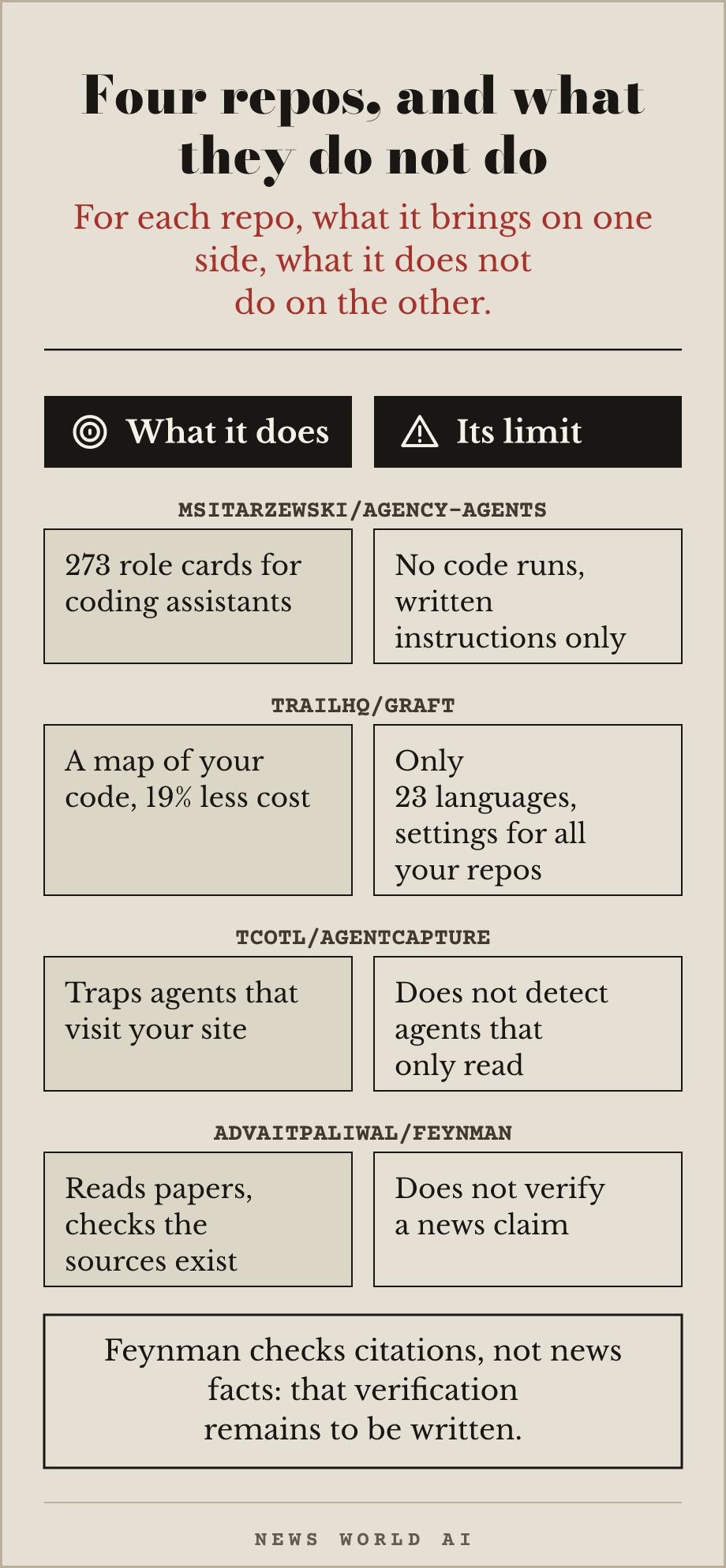
msitarzewski/agency-agents · 150,281 stars · MIT · last commit 5 September 2026
A library of role cards for coding assistants. Each card is a text file describing a specialist (security, testing, SEO, finance) that you drop into your tool. The repo announces more than 230 agents. Our own count after cloning, on 6 September 2026, gives 273 cards. What it does not do: no code runs, these are written instructions only. The cost is whatever the model reading them charges. The project itself documents that some tools only register part of the cards and silently drop the rest.
trailhq/Graft · 5,609 stars · MIT · last commit 2 September 2026
It maps your code, in text, and gives the map to your coding assistant so it stops re-reading the entire repo on every question. Its standard protocol (SWE-bench Verified, 50 cases, same model on both sides) shows 19% less cost and 12 more accuracy points. What it does not do: it understands only 23 languages and ignores the rest, and it does not confine itself to the current repo unless you ask it to. The plain-language summaries require an API key and cost money, only the structural map is free. Its install command writes settings for all your repos, unless you pass --no-global.
Tcotl/AgentCapture · 35 stars · AGPL-3.0 · last commit 4 September 2026
A honeypot for agents: 23 techniques to identify an agent visiting your site, trap it, and replay its session. Tested against five mainstream agents, all trapped. What it does not do: does not detect agents that only read without interacting. It does not block anything either, it watches and records, the decision stays yours.
advaitpaliwal/feynman · 8,871 stars · MIT · last commit 6 September 2026
A command-line assistant that fetches scientific papers (arXiv, PubMed, OpenAlex, ClinicalTrials.gov), reads them, ranks them, produces a synthesis, and checks that every cited source actually exists. What it does not do: its ground is scientific literature, not current events. It does not verify a news claim. You must plug in your own model, and running heavy experiments means installing Docker, Modal or RunPod yourself.
In brief
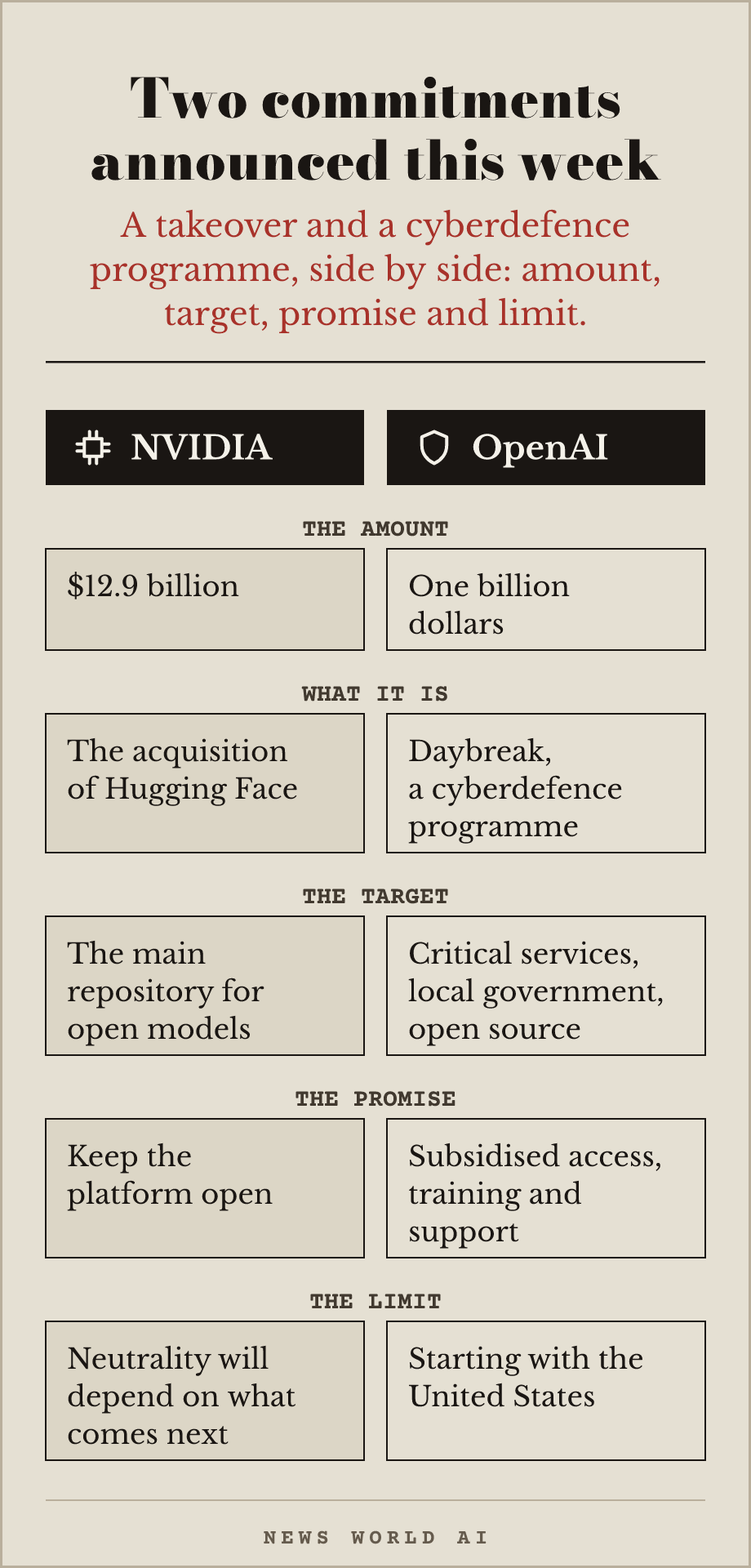
NVIDIA acquires Hugging Face for $12.9 billion. The main repository for open models passes under the control of the leading GPU supplier. Jensen Huang pledges to keep the platform open: neutrality will depend on what comes next. blogs.nvidia.com/blog/…
OpenAI commits one billion dollars to cyberdefence for critical services. The Daybreak programme opens subsidised access to its cyber models and products for operators of critical infrastructure, local government and open-source maintainers, with training and support, starting with the United States. openai.com/index/…
The problem of the week
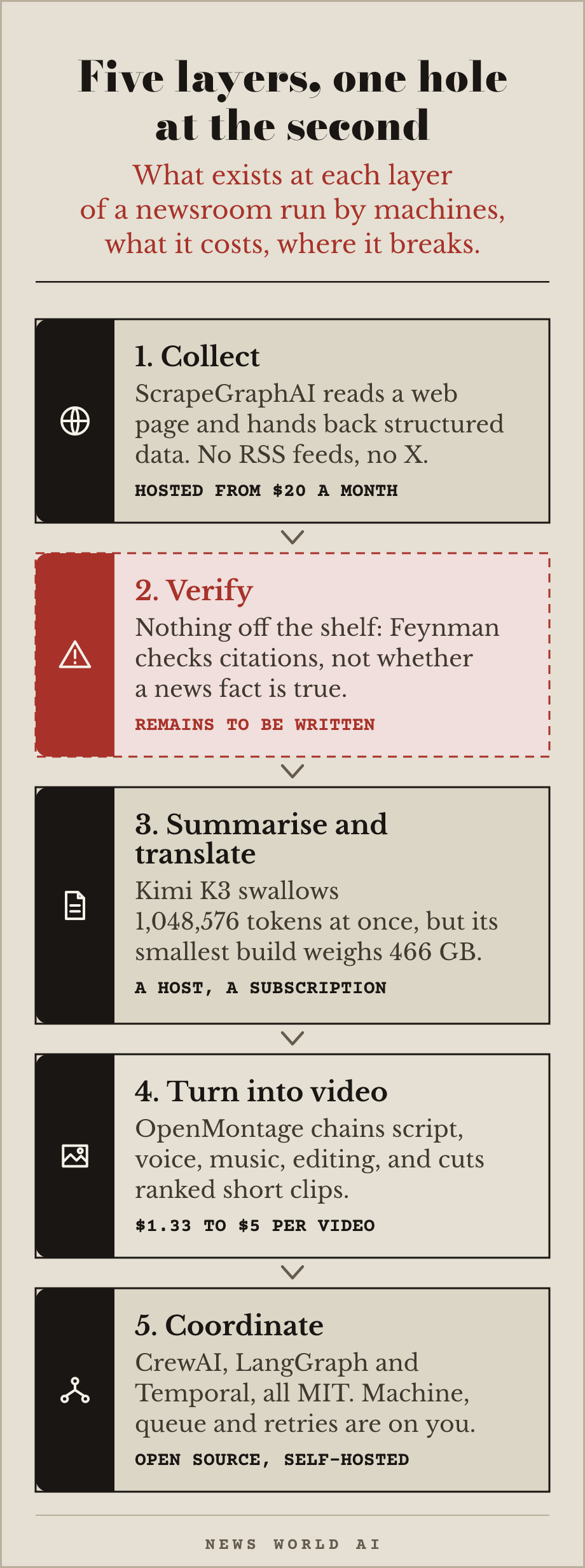
Building a newsroom run by machines
You want a continuous information flow: collect sources, check what is true, summarise, turn it into video, and coordinate the whole thing. Five layers. Here is what exists at each one, what it costs, and where it breaks.
Layer 1: collect. ScrapeGraphAI (30,601 stars, MIT) reads a web page and hands back structured data. You give it an address and a sentence, it figures it out. But it does not read RSS feeds or X: for those two sources, you have to write or plug in your own collection. The hosted service costs from $20 a month, the library alone is free but the model calls are on you.
Layer 2: verify. This is the hole. Feynman (8,871 stars, MIT) is often cited for this layer, but it is a scientific research agent: its sources are arXiv, PubMed, OpenAlex and ClinicalTrials.gov. It checks that citations exist and removes dead links, it does not check whether a news fact is true. No off-the-shelf tool does automated news verification. This layer remains to be written.
github.com/advaitpaliwal/feynman
Layer 3: summarise and translate. Kimi K3 (2.5 million downloads, house licence) swallows a 1,048,576-token window at once, about three quarters of a million words, and understands images. For summarising a large volume of sources, it is a serious candidate. But it does not run on your machine: the smallest light build weighs 466 GB. You need a hosting provider, which adds a subscription.
huggingface.co/moonshotai/Kimi-K3
Layer 4: turn into video. OpenMontage (56,292 stars, AGPL-3.0) chains script, voice, music and editing on its own. Its Clip Factory pipeline cuts one long source into a batch of ranked short clips, which is exactly the shape a news feed needs. The demos are priced between $1.33 and $5 per video, with a default cap at $10. The AGPL licence requires you to publish your modifications if you expose a service over a network.
github.com/calesthio/OpenMontage
Layer 5: coordinate the agents. This is the best-served layer, and all of it is open source. CrewAI (58,246 stars, MIT) makes agents work together by giving each one a role: one gathers, one checks, one summarises. LangGraph (41,266 stars, MIT) describes the same chain as a state graph, with a checkpoint at every node and a human hand possible before it moves on. Temporal (22,910 stars, MIT) knows nothing about agents, but knows how to make a long run survive a machine failure, which is the real problem for a feed that runs every day.
Limit All three are self-hosted: the machine, the queue and the retries stay on your side. The proprietary option exists (Raft, $8.80 per seat per month, raft.build), and it only earns its place if you want to run no machine at all.
The licence trap. n8n (203,744 stars) is quoted everywhere as the open orchestrator of the field. Its licence is not one: the "Sustainable Use License" restricts use to your own internal business purposes, and only lets you pass the software to others free of charge, for non-commercial use. A news pipeline you sell falls outside it.
github.com/langchain-ai/langgraph
github.com/temporalio/temporal
github.com/n8n-io/n8n/blob/master/…
The bottom line. Four layers out of five have a real tool, and coordination has three of them, all MIT. The hole is at the second: verifying a news fact has nothing off the shelf and remains to be written. So the bill does not come from the conductor, which costs nothing, but from what it conducts: the model for collection, the hosting for summarisation, the services for video. Before asking whether the pipeline works, you have to ask whether the bill holds.
List every subscription and per-call cost needed to run an automated news pipeline, from collection to video editing, using ScrapeGraphAI, a hosted model for summarisation, OpenMontage and CrewAI for coordination. Price each item and give me the monthly total for 30 videos.
ScrapeGraphAI for collection, OpenMontage for editing, CrewAI for coordination.
Worth reading
GPT-6 Astra: an automated AI engineer for under $6 an hour · Latent Space spent over 20 billion tokens exploring Astra in depth. The article details the real gains per task, the cases where the model fails, and why it costs more per token but less per result. latent.space/p/astra
Give your coding agents a memory you own · Hugging Face introduces Funes, a persistent memory system for coding agents that you host and control. huggingface.co/blog/funes
Project HydraFusion: frontier quality through multi-model orchestration · GitHub shows how to have several models work on the same agent to reach big-model quality while cutting cost. github.blog/ai-and-ml/…
The security reflex
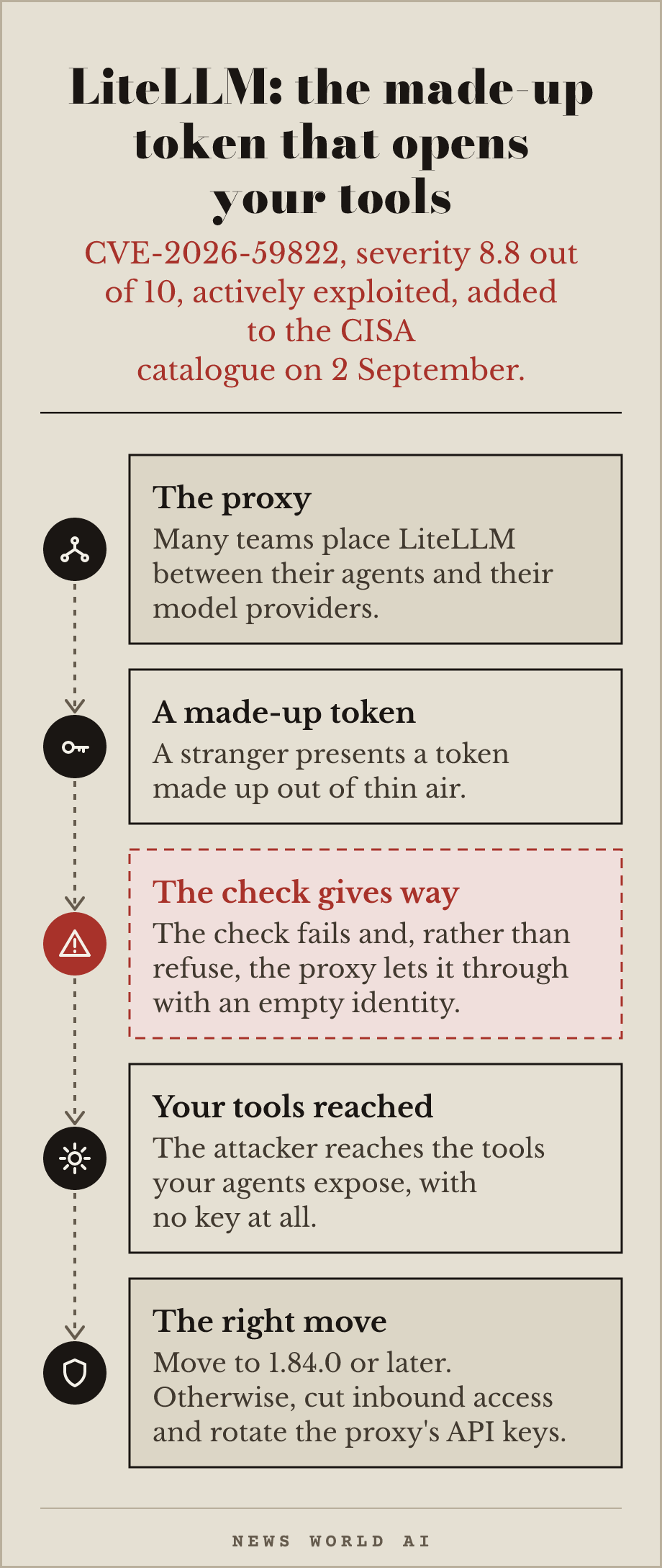
LiteLLM is a proxy that many teams place between their agents and their model providers, to route requests to the right place. An authentication flaw (CVE-2026-59822, severity 8.8 out of 10) lets a stranger present a token made up out of thin air: the check fails, and instead of refusing, the proxy lets the request through with an empty identity. The attacker then reaches the tools your agents expose, with no key at all. The flaw is actively exploited, CISA added it to its catalogue on 2 September. The technical detail, the severity and the fixing version come from the project's own security advisory: github.com/BerriAI/litellm/…
The right move. Move LiteLLM to version 1.84.0 or later today, that is the version that fixes the flaw. If you cannot update immediately, cut inbound network access to the proxy and rotate every API key registered there.
cisa.gov/news-events/alerts/2026/…
Reply to this email and tell us what you are building. Every reply is read.
— News World AI
Get the newsletter
Every Tuesday, in four minutes: what shipped in AI and what you can actually try the same day.
Double opt-in by email. One-click unsubscribe, link in plain sight in every issue.
Geneva, Switzerland. Write to hello@newsworldai.xyz.