News World
Your agent succeeds one time in three
Hello,
News World AI lands twice a week, Tuesday and Friday, in four minutes: what shipped in AI and what you can actually try the same day.
Who it's for: people building agents, from the simplest projects to the ones that push models hard, and people using AI seriously at work.
What sets us apart fits in one line: we don't reprint announcements. For every item, one sentence of fact, one sentence of consequence, and the link to the original document. When we don't know, we say so.
Here is a full issue, with the six sections that will come back every time.
Releases
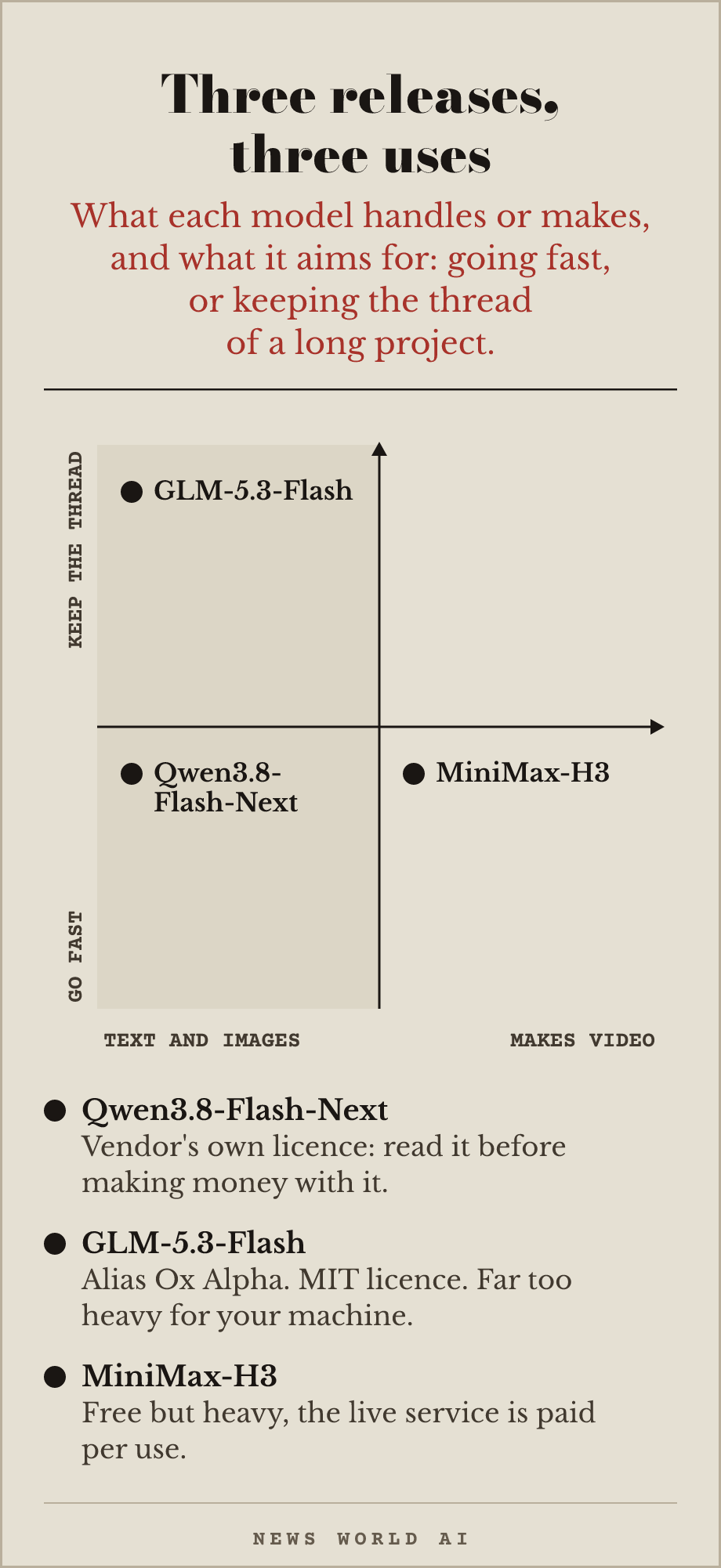
Qwen3.8-Flash-Next
What it's for the small tasks you run a thousand times a day, where every second and every cent counts, and reading images alongside text.
The counters 208,000 downloads, 4,580 likes, plus 431,000 downloads of the light build.
The limit the licence is the vendor's own, not Apache: read it before you make money with it. No image generation.
→ huggingface.co/Qwen/Qwen3.8-Flash-Next, and unsloth/Qwen3.8-Flash-Next-GGUF for the build that runs on your own machine, with nothing leaving it.
GLM-5.3-Flash, alias Ox Alpha
The story of the week. A model with no vendor name appeared on OpenRouter, free, under the handle Ox Alpha, and started beating the best on the leaderboards. Public detective work, tokenizer analysis, online betting. Then the Chinese lab Z.ai confirmed it itself: this was its GLM-5.3-Flash, put there as a full-scale live test to collect real usage before the announcement. The weights are now downloadable.
What it's for carrying a long project without losing the thread, with text and images mixed. Sparse architecture, 320 billion parameters of which only 18 work on each word: that is what makes it cheap to run.
The counters 441,348 downloads last month, 1,930 likes, MIT licence, 300,000 words of context.
The limit nobody has tested it independently since it was unmasked, and it is far too heavy to run on your machine: you go through a hosted service.
→ huggingface.co/zai-org/GLM-5.3-Flash, and Z.ai's own announcement lifting the pseudonym.
MiniMax-H3, video faster than real time
What it's for turning a sentence or a picture into video, without the wait.
The counters 5.5 million downloads of the open weights.
The limit the model is free but heavy, and the service that streams it live is paid per use.
Repos
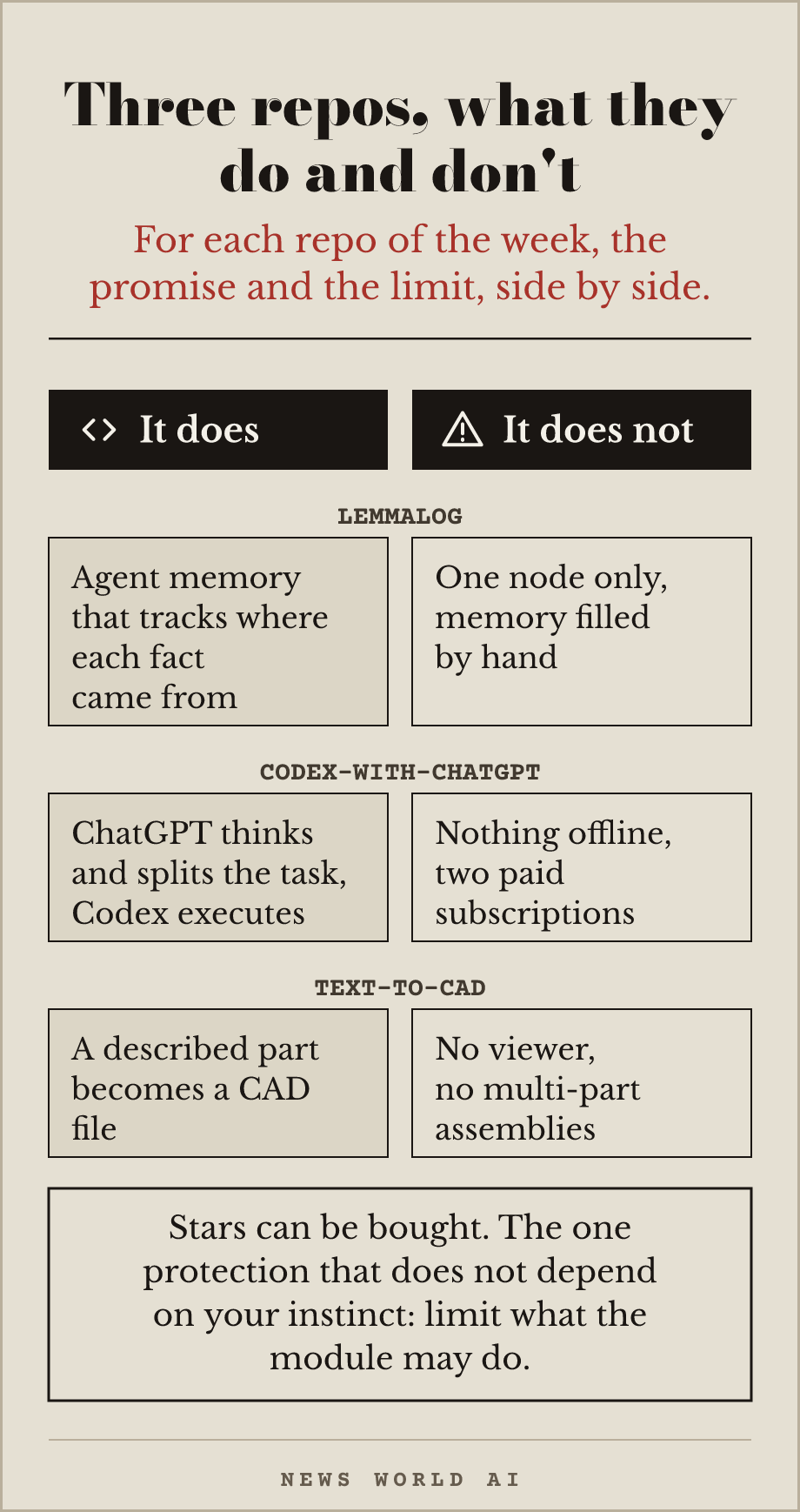
JordyZomer/lemmalog — 242 stars, MIT licence, last commit 27 August 2026 Memory for agents that keeps track of where each fact came from. Ships an MCP server, so it plugs straight into your agent.
What it does not do one node only, no distribution, and memory is filled by hand: nothing is extracted from conversations on its own.
Few stars, young project: that is normal and says nothing about quality. The risk here is not a trap, it is abandonment in three months.
→ github.com/JordyZomer/lemmalog
XiaoDuoYa/codex-with-chatgpt — 2,072 stars, MIT licence, last commit 28 August 2026 ChatGPT thinks and splits the task, Codex executes.
What it does not do nothing offline, and it leans on two paid subscriptions. If either provider closes the tap, the whole rig stops, and that does happen.
→ github.com/XiaoDuoYa/codex-with-chatgpt
earthtojake/text-to-cad — 14,101 stars, MIT licence, last commit 1 September 2026 Describe a part in plain English, get the computer-aided design file back.
What it does not do no viewer, you need external CAD software to open the result, and it does not handle multi-part assemblies.
→ github.com/earthtojake/text-to-cad
A warning that holds for the whole section. Stars can be bought, a few cents each. A project with fifty thousand stars, twelve forks and no discussion does not happen naturally. None of these tests proves anything, they only say where to look. The one protection that does not depend on your instinct is limiting what the module is allowed to do.
In brief
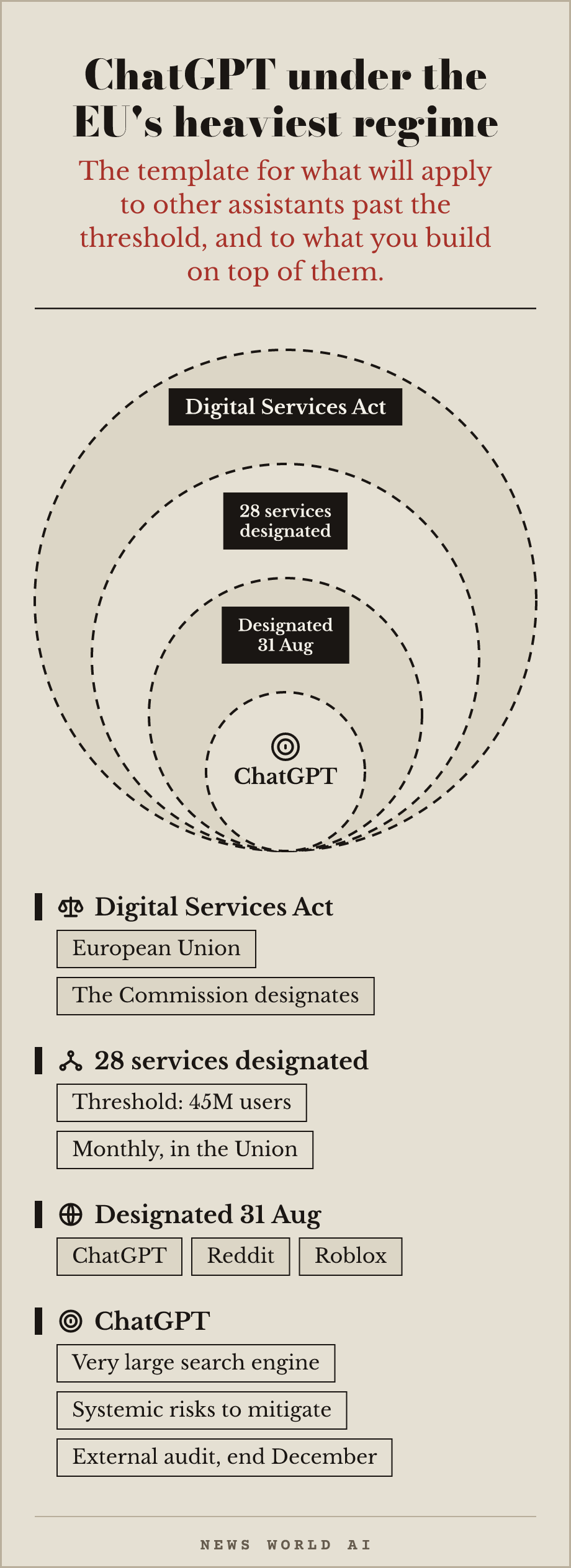
ChatGPT falls under the EU's heaviest regime. On 31 August the Commission designated it a very large online search engine under the Digital Services Act, alongside Reddit and Roblox. The threshold: 45 million monthly users in the Union. Four months, until the end of December, to assess and mitigate so-called systemic risks, protection of minors included, and to open its systems to external audit. Twenty-eight services are now designated.
What it changes for you this is the template for what will apply to other assistants as soon as they cross the threshold, and to whatever you build on top of them.
→ European Commission press release
This box is waiting for you
You built an app, a repo, a project, and you want our readers to see it. Tell us in four fields what it does, what it does not do, and where to find it. Selection is editorial and free. The day this slot is sold, it will carry its label in plain sight, and the advertiser will never be presented as a discovery in the same issue.
The problem of the week
Your agent succeeds one time in three, and the model is not the reason.
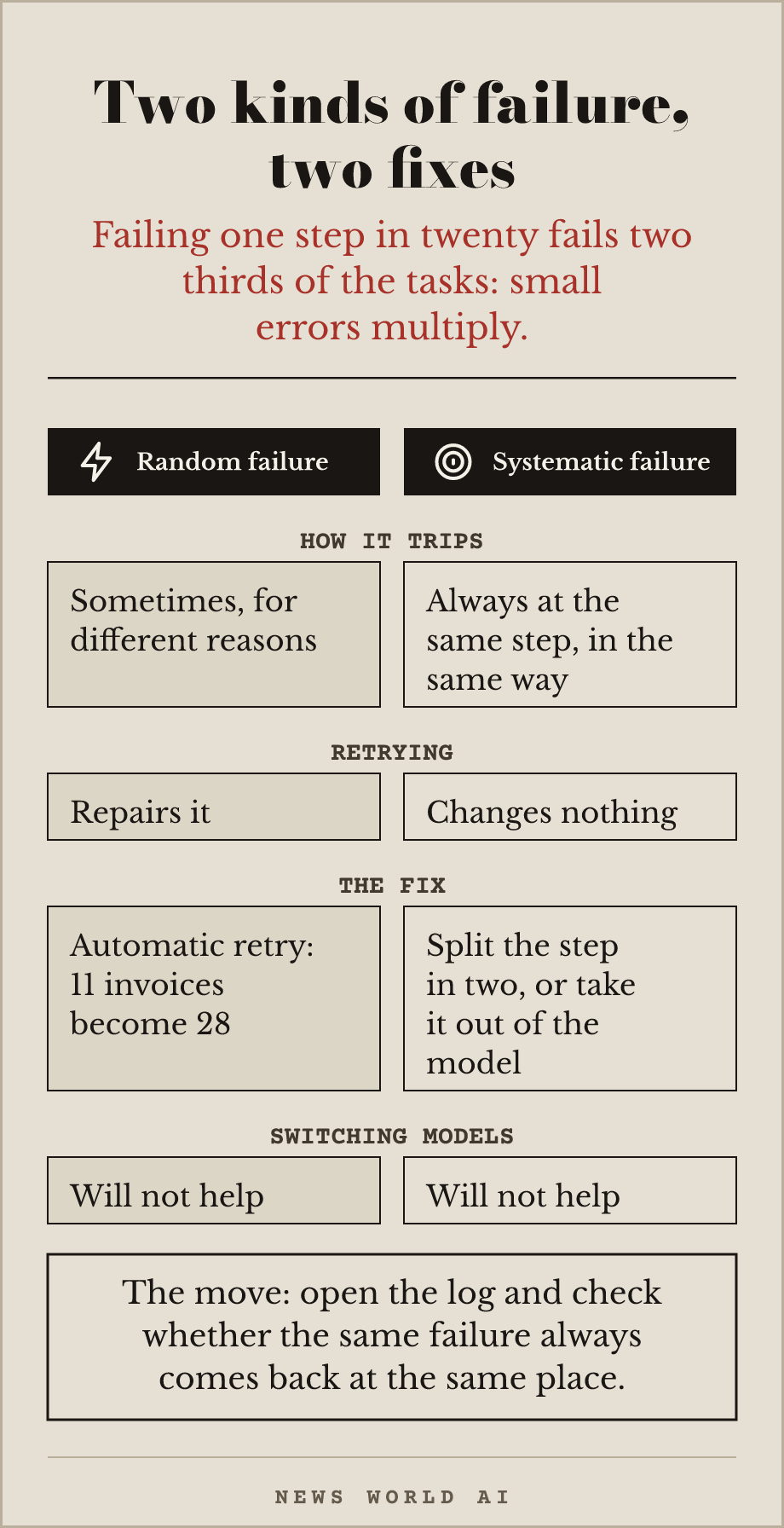
An agent that fails one step in twenty fails two thirds of its tasks. That is not bad luck: a long task has to get every step right, and small errors multiply instead of adding up.
Let's keep one concrete case to the end: an agent that processes invoices arriving by email. Read the message, open the attachment, pull the amount, find the supplier, convert the currency, post the entry, acknowledge receipt. Around twenty steps. Out of thirty invoices this month, eleven make it through.
Switching models will not help, and you have no code to write. There are two kinds of failure, and confusing them costs days. Random failure trips sometimes, for different reasons: an automatic retry repairs it, and your eleven invoices become twenty-eight.
Systematic failure trips always, at the same step and in the same way: retrying changes nothing, you have to split the step in two or take it out of the model.
The move, today: open your agent's log and look at whether the same failure always comes back at the same place. That is the whole difference between an hour's repair and a lost week.
→ The four prompts that find where your agent fails, to paste one after the other into your assistant. They list the real steps, add a log, run the task ten times in dry-run mode, and hand back a table that separates the two kinds of failure.
Worth reading
The load-bearing vocabulary of Claude
Which words, present or missing from an instruction, actually change what the model does. Measured, not guessed. Read it before you write your next system prompt.
Understanding ChatGPT Work
Simon Willison untangles OpenAI's most confusing product, which is really two products. Useful if your company is adopting it.
A cross-vendor audit loop
An agent should not grade its own homework: models from the same vendor share blind spots. The paper proposes having the work checked by a model from somewhere else.
The security reflex
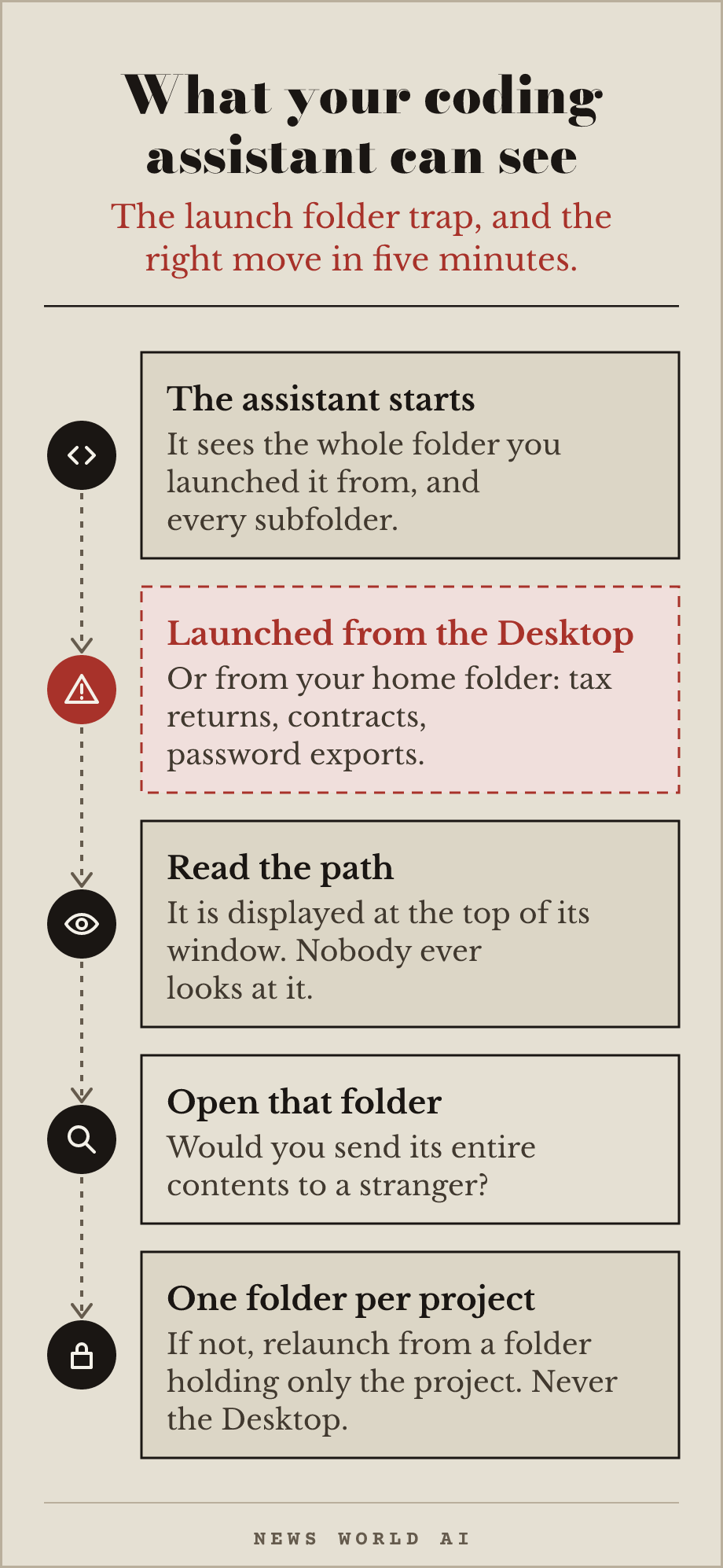
The trap. A coding assistant sees everything in the folder you launched it from,
and in every subfolder. Launched from your home folder or your Desktop, it has your tax returns, your contracts and your password exports. The path is displayed at the top of its window, and nobody ever looks at it.
The right move, five minutes. Open that folder and ask yourself one question: would I send its entire contents to a stranger? If the answer is no, close it, create a folder holding only the project at hand, and relaunch from there. One folder per project, never your account root, never the Desktop.
### Quantum insert — your data is already stolen
Why this concerns you: your agent transmits and logs data that will have to stay secret long after your project ends.
An attacker needs no quantum computer today. Recording encrypted traffic now and shelving it until the day it can be opened is enough. Today's encryption protects against today's reading, not against 2032's.
One question only: does the data my agent handles have to stay secret for more than ten years? Medical records, contracts, sources, industrial property. If yes, the subject is present tense, and resistant algorithms are already standardised. If no, sleep well on this particular point.
Quantum will never have a fixed section here. It shows up only as it does now: when it changes something about what you are building.
Submit your work
You built an app, a repo, a model, a project. Tell us in four fields what it does,
what it does not do, and where to find it. Selected submissions run in the box of the week. Selection is editorial and free, and we read everything.
The rhythm
Every Tuesday and every Friday, four minutes, these six sections: releases, repos, in brief, the problem of the week, worth reading, the security reflex. Sometimes an insert, when an outside subject genuinely changes something for you.
Four promises that will not move: nothing that cannot be traced to its original document, an insert justified in one sentence or no insert, a sponsor always
labelled and never covered editorially, and no content hidden behind a click. What the subject line promises is in the email.
The most useful thing you can do today: forward this issue to one person who is building something. That is how this newsletter grows, or doesn't.
Reply to this email and tell us what you are building. Every reply is read.
— News World AI
The unsubscribe link is right below, in plain sight. We will never hide it in light grey on a white background.
Get the newsletter
Every Tuesday, in four minutes: what shipped in AI and what you can actually try the same day.
Double opt-in by email. One-click unsubscribe, link in plain sight in every issue.
Geneva, Switzerland. Write to hello@newsworldai.xyz.